Culture
JUL 2026
Poems for Perception: The Poetry Consultancy x Funga
Perception, Attention, and Altered Sight in Oliver, Blake, Huxley, and Höller
Mary Oliver, William Blake, and Aldous Huxley occupy distinct positions in the literary tradition, yet each arrives at a shared conviction: that ordinary perception is both the instrument and the obstacle of genuine understanding. Oliver’s “The Summer Day” (1990), collected in House of Light, belongs to a body of work grounded in the American Transcendentalist inheritance, though Oliver recasts Emersonian attention as something deliberately unheroic, rooted in the minute and the perishable.¹ The
poem’s famous close, interrogating what the speaker intends to do with her “one wild and precious life,” is preceded by something more quietly radical: an account of watching a grasshopper clean her face, rendered with such scrupulous patience that perception itself becomes the subject rather than the means. Blake’s “Auguries of Innocence,” composed circa 1803 though not published until 1863, opens from an entirely different metaphysical position, one inflected by Neoplatonism and the dissenting visionary tradition.² Its opening quatrain, with its demand “to see a world in a grain of sand, and a heaven in a wild flower,” proposes not attentiveness to the empirical world but its complete transfiguration. Where Oliver narrows the field of vision, Blake insists that to perceive truly is to perceive through the particular into the infinite. Between these two poles, Huxley’s The Doors of Perception (1954) operates as a pharmacological experiment in epistemology.³ Huxley’s account of his mescaline experience is, at its core, a philosophical argument: that the human nervous system functions as a reducing valve, filtering out far more of reality than it admits, and that certain chemical agents dissolve that filter. The title’s debt to Blake is explicit and deliberate, lifting its phrase from The Marriage of Heaven and Hell: “If the doors of perception were cleansed every thing would appear to man as it is, Infinite.”⁴
Carsten Höller’s Giant Triple Mushroom (2024), installed in the Place Vendôme in Paris, is an aluminium sculpture in Höller’s sustained series of oversized fungal forms, a body of work rooted in his scientific background in entomology and his long-standing investigation into hallucinatory experience, disorientation, and the instability of consensual reality.⁵ The mushroom, particularly the Amanita muscaria, carries an iconographic weight in the history of altered states that Höller mobilises with precise irony: placed within one of Paris’s most aggressively ordered classical spaces, the sculpture introduces a form associated with perceptual disruption into an architectural environment built to assert rational control. The connection to Oliver, Blake, and Huxley is thematic rather than formal, but it is exact. All four works concern the act of looking again, of discovering that what appears fixed and legible is neither.
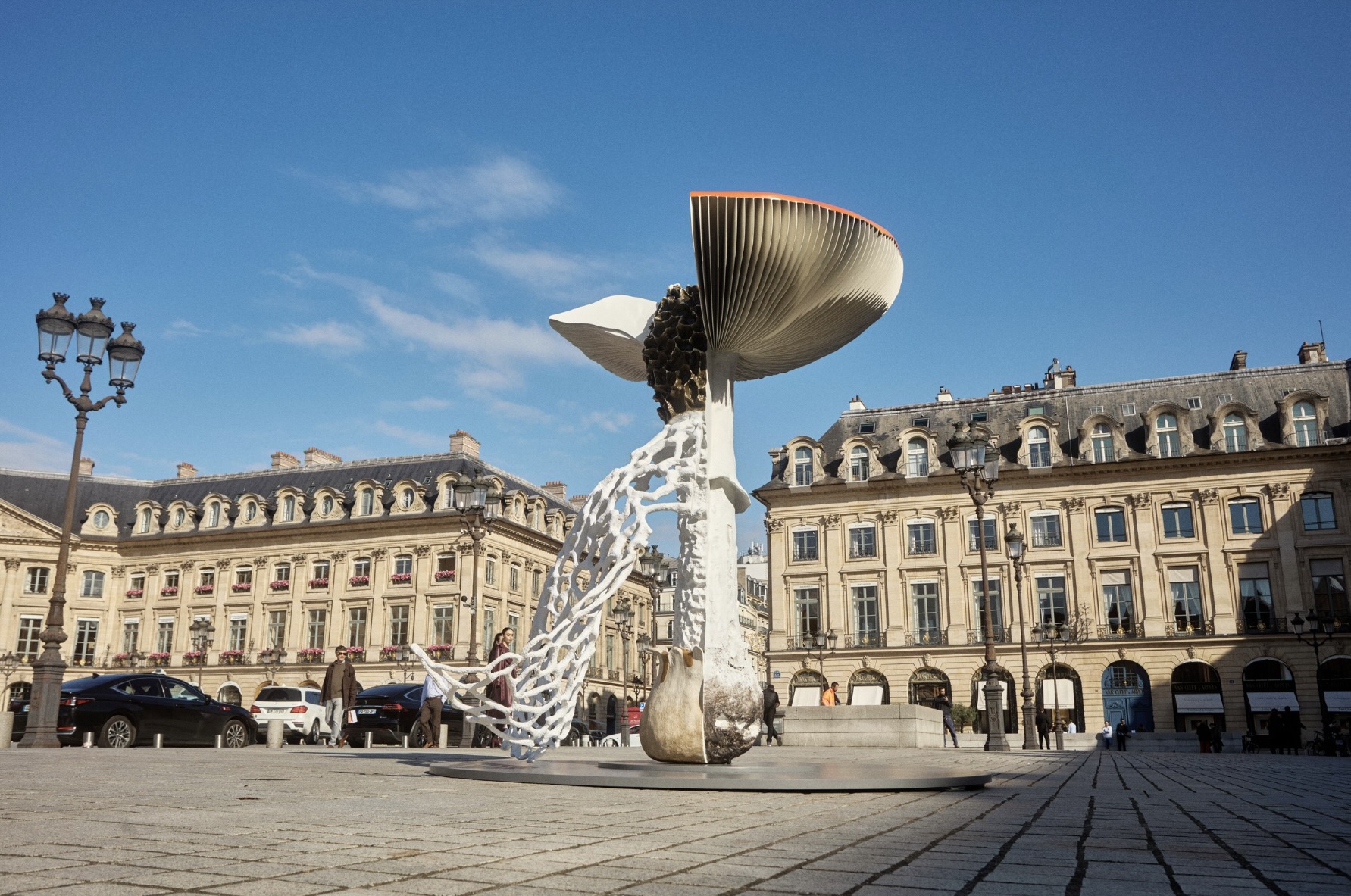
Carsten Höller, Giant Triple Mushroom, 2024, Installation View, Place Vendôme, Paris © Carsten Höller. Photo: Pierre Björk,
Courtesy: Gagosian
That intellectual history matters now because the questions these works raise have moved from the margins to the centre of scientific and cultural debate. The neuroscience of psychedelics, the phenomenology of contemplative attention, and the philosophy of perceptual reduction are no longer peripheral interests: they are subjects of serious clinical research and institutional funding.6 Oliver’s grasshopper, Blake’s grain of sand, Huxley’s dissolved reducing valve, and Höller’s disorienting aluminium mushroom in the heart of imperial Paris collectively argue that the threshold between ordinary and extraordinary perception is thinner, and more consequential, than the culture has generally been willing to admit.
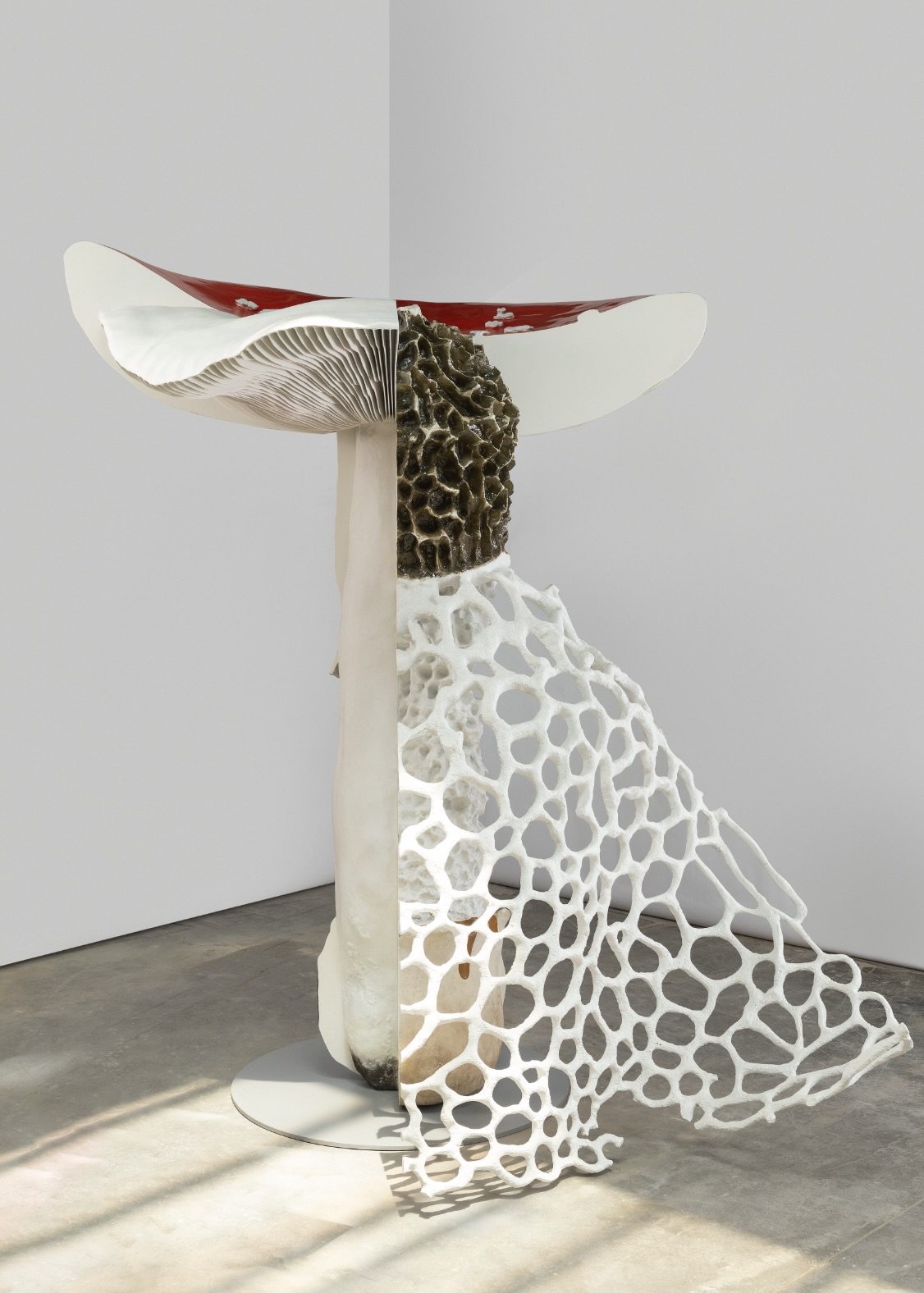
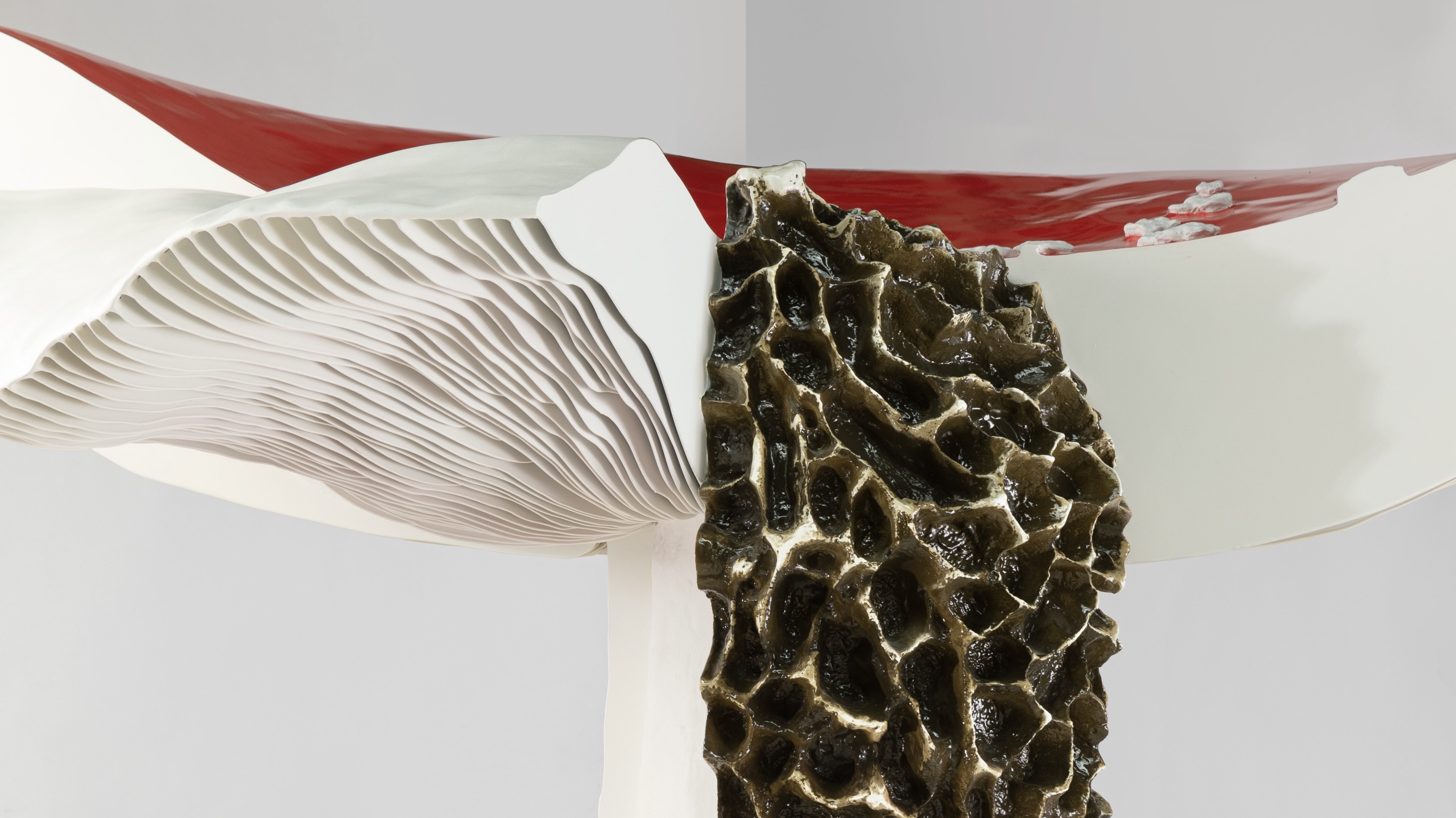
Carsten Höller Giant Triple Mushroom, 2024 (Fly agaric / Long Net Stinkhorn / Dove-coloured Tricholoma) Aluminum, stainless steel, and paint 118 ⅛ × 116 ⅛ × 94 ½ inches (300 × 295 × 240 cm) Courtesy: Gagosian
Funga’s own engagement with altered states begins from precisely the premise that Oliver, Blake, Huxley, and Höller each arrive at in turn: that ordinary perception is neither final nor complete, and that what lies beyond its ordinary threshold merits the same rigour, scepticism, and attention that Oliver brings to a grasshopper, that Blake brings to a grain of sand, that Huxley brings to his own dissolved reducing valve, and that Höller renders in aluminium at the centre of an imperial square. The present collaboration between The Poetry Consultancy and Funga follows directly from that shared premise. It is not an arbitrary pairing of poetry with a psychedelics education platform, but a natural one, arising from a conviction common to both projects: that perception, properly interrogated rather than simply
trusted, discloses more than it first appears to.
Notes
1. Oliver, Mary, House of Light (Boston: Beacon Press, 1990), p. 60. On Oliver’s relationship to the Transcendentalist tradition, see Bonds, Diane S., ‘The Language of Nature in the Poetry of Mary Oliver’, Women’s Studies, 21 (1992), pp. 1–15 (p. 3).
2. Erdman, David V ., Prophet Against Empire: A Poet’s Interpretation of the History of His Own Times
(Princeton: Princeton University Press, 1954), p. 311. ‘Auguries of Innocence’ survives in the Pickering Manuscript and was first published in Alexander Gilchrist’s Life of William Blake (1863).
3. Huxley, Aldous, The Doors of Perception (London: Chatto and Windus, 1954), pp. 22–23.
4. Blake, William, ‘The Marriage of Heaven and Hell’, in The Complete Poetry and Prose of William Blake, ed. by David V . Erdman (New York: Anchor Books, 1988), p. 39.
5. Birnbaum, Daniel, ‘Carsten Höller: The Logic of the Experiment’, Artforum, 44 (2006), pp. 210–17 (p. 212).
6. Carhart-Harris, Robin, and Guy Goodwin, ‘The Therapeutic Potential of Psychedelic Drugs: Past, Present, and Future’, Neuropsychopharmacology, 42 (2017), pp. 2105–13 (p. 2106).
The Poetry Consultancy is a curatorial practice that pairs poetry with the work of artists and photographers, on behalf of galleries, foundations, and cultural platforms. It began in Mexico City, where its founder, Matilda Fender, held gatherings around poetry and tea, and separately composed and gifted hundreds of poems, each transcribed by hand onto paper from a local papelería and enclosed in a handmade envelope. These two practices have since converged into the discipline the Consultancy now practises.
Matilda Fender
The Poetry Consultancy | @thepoetryconsultancy